Synergies with other EU projects

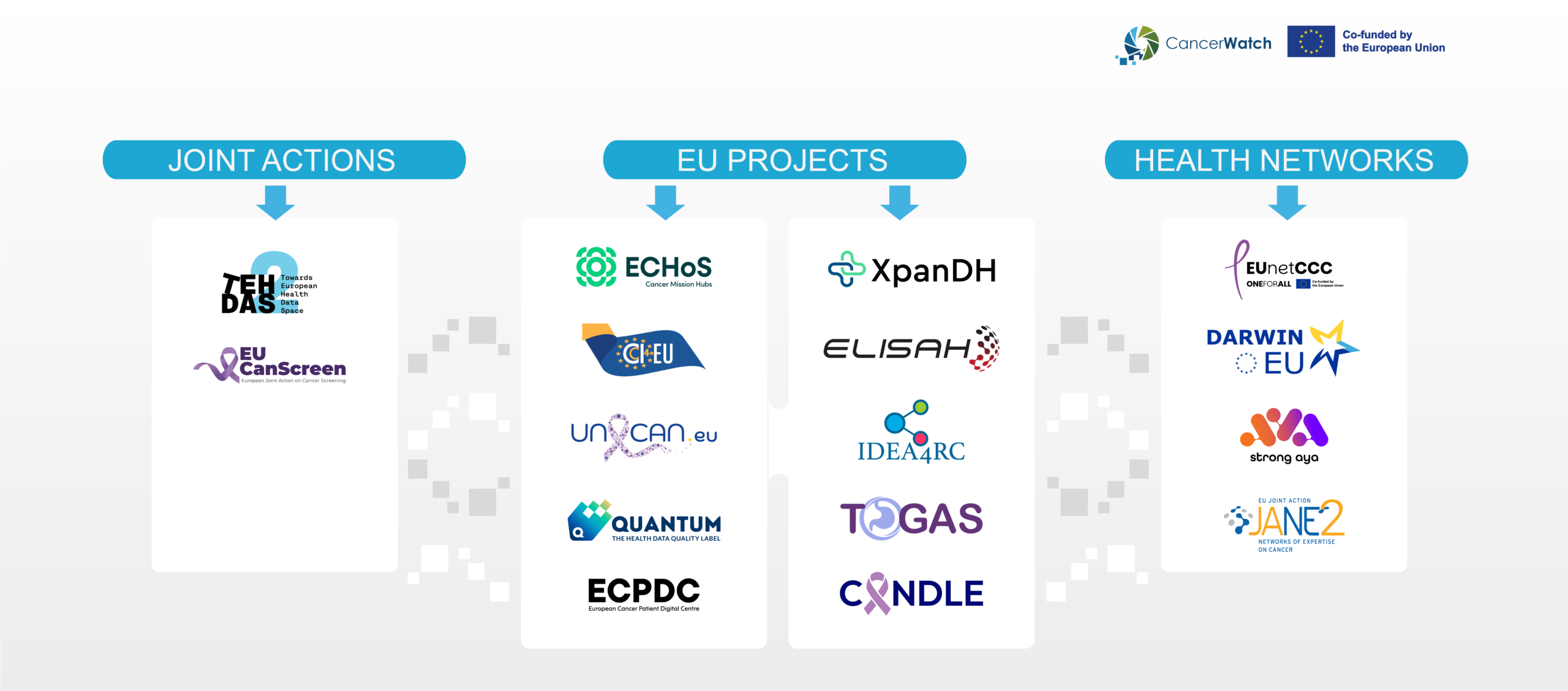
We believe in the power of partnership to transform cancer care. This section showcases our active collaborations with other Joint Actions, European Projects, and Health Networks to ensure we are sharing knowledge and working efficiently. By aligning our efforts with these key partners, we maximize our collective impact and build a stronger, more connected health community across Europe.

Interactions and synergies with related projects

1. DARWIN EU
  • Focus of the project: A federated network providing the EMA with Real-World Evidence (RWE) on medicine safety and efficacy using standardized healthcare data (OMOP CDM) from across Europe.
  • CancerWatch’s engagement: Ensures that cancer registry data is standardized and digitized to meet DARWIN EU’s high-quality technical requirements for regulatory use.
  • Mutual benefits: DARWIN EU gets faster access to “fit-for-purpose” cancer data; CancerWatch aligns registries with regulatory-grade standards, increasing their impact on European health policy and medicine approval.
2. STRONG-AYA
  • Focus of the project: Focuses on adolescents and young adults (AYAs) with cancer. It aims to establish a European data infrastructure and a “Core Outcome Set” (COS) to improve research, clinical practice, and healthcare services specifically tailored to the unique developmental stage of young patients.
  • CancerWatch’s engagement: CancerWatch can integrate the AYA-specific data standards and outcomes into its broader harmonization efforts for Population-Based Cancer Registries (PBCRs).
  • Mutual benefits: STRONG-AYA benefits from CancerWatch’s infrastructure for long-term data sustainability and registry integration, while CancerWatch gains high-quality, age-specific indicators that are currently often overlooked in general registries.
3. TOGAS (Towards Gastric Cancer Screening Implementation)
  • Focus of the project: Aims to provide missing evidence-based knowledge for implementing gastric cancer screening across the EU. It focuses on H. pylori screening, cost-effectiveness, and early detection of precancerous lesions.
  • CancerWatch’s engagement: CancerWatch provides the “monitoring” backbone. By improving the timeliness and quality of registry data, it can help TOGAS track the real-world impact of new screening pilots on gastric cancer incidence and mortality.
  • Mutual benefits: TOGAS relies on accurate registry data to validate its screening models; CancerWatch benefits from TOGAS’s focus on early-stage data and screening outcomes to refine its “prevention and early detection” data modules.
4. ELISAH (European Linkage of Initiative from Science to Action in Health)
  • Focus of the project: Aims to reduce the breast cancer burden by acting on modifiable risk factors (pollution, nutrition, tobacco, alcohol). It focuses on the link between environmental determinants and cancer, with a strong emphasis on reducing health inequalities.
  • CancerWatch’s engagement: CancerWatch facilitates the “Gap Analysis” by providing the population-based data needed to map breast cancer rates against environmental and lifestyle risk factors.
  • Mutual benefits: ELISAH develops digital tools (like the BRCApp) that can feed patient-reported data back into registries; CancerWatch provides the historical and comparative data necessary for ELISAH to measure the success of its prevention interventions.
5. IDEA4RC (Intelligent Ecosystem for Rare Cancers)
  • Focus of the project: Developing a specialized data ecosystem for rare cancers to overcome the challenges of small patient populations. It uses AI and Natural Language Processing (NLP) to extract structured data from clinical records.
  • CancerWatch’s engagement: Rare cancer data is a priority for CancerWatch. The projects can collaborate on technical solutions for “GDPR-compliant” data sharing and the “FAIRification” (Findable, Accessible, Interoperable, Reusable) of data.
  • Mutual benefits: IDEA4RC provides advanced AI tools for data extraction that CancerWatch can scale to other registries. CancerWatch offers the large-scale European Cancer Information System (ECIS) integration that allows IDEA4RC’s findings to reach national policymakers.
6. CANDLE
  • Focus of CANDLE: Building an infrastructure of cancer data nodes.
  • CancerWatch’s engagement: CancerWatch collaborates with CANDLE to ensure coherence and complementarity in data infrastructure efforts. This includes sharing methodologies, tools, and outputs that can integrate with CANDLE’s network of cancer data nodes.
  • Mutual benefits:
    • CancerWatch gains access to structured cancer data networks that support its analyses and reporting.
    • CANDLE benefits from CancerWatch’s interim findings, policy-relevant insights, and innovative dissemination approaches, which can enhance the visibility and utility of CANDLE’s infrastructure.
7. ECHoS
  • Focus of ECHoS: Creating a network of National Cancer Mission Hubs.
  • CancerWatch’s engagement: CancerWatch aligns its dissemination and stakeholder engagement activities with ECHoS hubs. This includes co-organizing sessions, promoting cross-project events, and integrating project outputs into national hubs.
  • Mutual benefits:
    • CancerWatch leverages ECHoS hubs to reach national stakeholders, including ministries and healthcare providers, ensuring local impact of its tools and findings.
    • ECHoS gains from CancerWatch’s innovative tools, interim results, and policy insights to support hub-level decision-making and knowledge sharing.
8. EUnetCCC
  • Focus of EUnetCCC: Creating a network of Comprehensive Cancer Centres.
  • CancerWatch’s engagement: CancerWatch works with EUnetCCC to co-promote outputs, participate in joint dissemination activities, and integrate findings relevant to comprehensive cancer care.
  • Mutual benefits:
    • CancerWatch can test and showcase innovative methodologies within EUnetCCC centres and gather feedback from expert practitioners.
    • EUnetCCC gains insights from CancerWatch’s analyses, which can inform evidence-based improvements and policy-relevant recommendations across the network.
  •  

9. UNCAN (Understanding Cancer)
  • Focus of UNCAN: An initiative (Flagship 7 in the Beating Cancer Plan) aimed at understanding cancer through a centralized platform.
  • CancerWatch’s engagement: CancerWatch JA will align with WP6 to ensure data interoperability with the UNCAN platform. It is part of a consortium for Mission calls led by VHIO and BCS.
  • Mutual benefits: CancerWatch ensures its data is in scope for Mission calls (HORIZON-MISS-2024-CANCER-01-01), while UNCAN gains integrated ENCR data.

10. CanScreen-ECIS / EUCanScreen
  • Focus of CanScreen-ECIS: Including insights from European cancer screening data into the European Cancer Information System (ECIS).
  • CancerWatch’s engagement: CancerWatch seeks engagement with EUCanScreen partners to ensure alignment on the ECIS roadmap and will review data linkage opportunities between screening and registry data in WP6.
  • Mutual benefits: CancerWatch benefits from harmonized indicators for complex screening data; EUCanScreen ensures its strategy for quality management is aimed for inclusion in ECIS.

11. QUANTUM
  • Focus of QUANTUM: Developing a data quality and utility label for the European Health Data Space (EHDS).
  • CancerWatch’s engagement: CancerWatch will evaluate and apply the QUANTUM label in WP5 and seek to align software processes for generic vs. cancer-specific data quality measures.
  • Mutual benefits: QUANTUM’s labels are tested in a specialized domain; CancerWatch gains a standardized framework for data utility.

12. CCI4EU
& JANE-2
  • Focus of CCI4EU/JANE-2: Assessing Comprehensive Cancer Infrastructures (CCIs) and defining Networks of Expertise (NoE).
  • CancerWatch’s engagement: Collaboration is established to strengthen Population-Based Cancer Registries (PBCRs) at CCIs. CancerWatch will discuss how PBCRs can contribute to assessing NoEs.
  • Mutual benefits: CCI4EU strengthens local registry coverage; CancerWatch provides the data necessary to identify and address gaps in expertise networks.

13. TEHDAS2 & XpanDH
  • Focus: Developing guidelines for cross-border health data use and the adoption of the European Health Data Exchange Format (EEHRxF).
  • CancerWatch’s engagement: WP5 will collaborate with TEHDAS2 to integrate ENCR data into EHDS infrastructure and interact with XpanDH to apply exchange formats for secondary use.
  • Mutual benefits: These projects establish the technical infrastructure, while CancerWatch provides the primary use case for cancer data registration and exchange.

14. ECPDC (European Cancer Patient Digital Centre)
  • Focus of ECPDC: Providing digital information and resources directly to European citizens and patients.
  • CancerWatch’s engagement: Establishing contacts to ensure insights from ENCR/ECIS data are used to inform patients and survivors.
  • Mutual benefits: Patients gain access to population-based statistics; CancerWatch increases the societal impact and visibility of its data.
Privacy summary

The website owner is committed to protecting the privacy of users who access this website and/or any of its services. Use of the website and/or any of the services offered by the website owner implies the user’s acceptance of the provisions contained in this Privacy Policy and that their personal data will be processed as stipulated herein.

Please note that although our website may contain links to other websites or social networks, this Privacy Policy does not apply to the websites of other companies or organizations to which the website may redirect. The website owner does not control the content of third-party websites, nor accepts any responsibility for the content or privacy policies of such websites.